If you are running an import or export business in Australia, your bottom line hinges on a single, crucial decision: how to get your stock across the border without blowing out your budget or leaving your customers hanging.
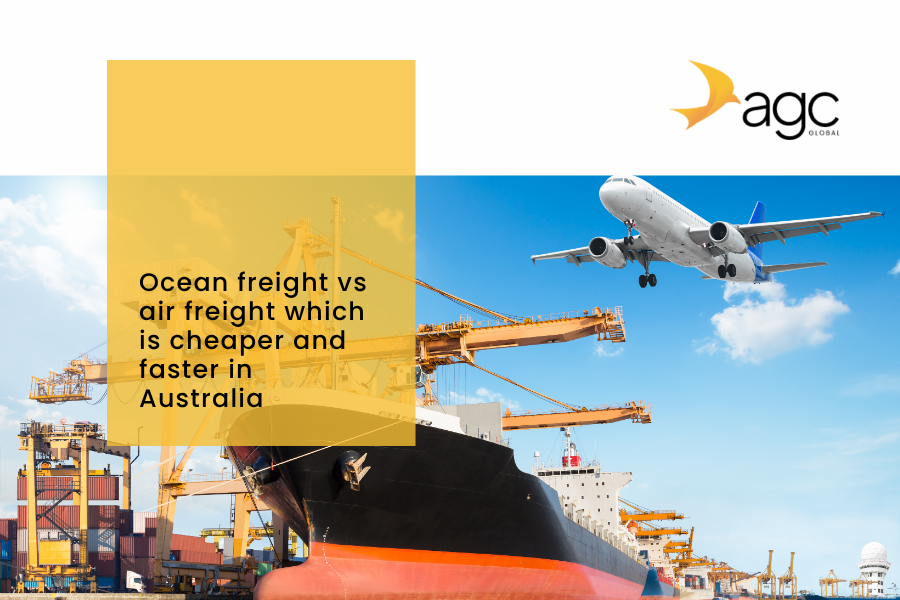
In international shipping, the ultimate battle is always ocean freight vs air freight. Conventional wisdom says that sea cargo is cheap and slow, while air cargo is expensive and fast. But in today’s volatile global supply chain, that rule of thumb doesn’t tell the whole story. Local wharf ancillary fees are rising; port congestion is volatile, and international flight capacities shift weekly.
Whether you are importing from China, Europe, or India, calculating your true landed cost matters. Let’s break down which shipping method is cheaper and faster for your Australian business.
The Ultimate Showdown: Air Cargo vs Sea Cargo
Before we dive into the specific mechanics of Australian logistics, let’s look at a straightforward comparison of how ocean shipping vs air shipping perform across key operational metrics.
| Feature | Air Freight Services | Ocean Freight Services |
| Average Speed to Australia | 3 to 10 days (all-inclusive) | 18 to 45 days (depending on the trade lane) |
| Pricing Baseline | High: ~$3 to $10+ USD per kg | Low: ~$50 to $150 USD per CBM (LCL) |
| Reliability | Very High (daily flights, tight schedules) | Moderate (subject to port strikes, rollovers) |
| Tracking Granularity | Real-time, flight-by-flight updates | Milestone-based (vessel tracking) |
| Environmental Impact | ~500g CO2e per tonne-km | ~10 to 40g CO2e per tonne-km |
Which is Faster? Navigating Australian Transit Times
When speed is your primary performance indicator, air freight services win hands down. Because Australia is geographically isolated from major manufacturing hubs, transit times via the sea can take weeks, whereas planes cut that down to days.
Air Freight Transit Times
International air cargo heading into major Australian airports like Sydney (SYD), Melbourne (MEL), and Brisbane (BNE) typically arrives within days.
- From Southeast Asia / China: 3 to 6 days.
- From Europe / UK: 7 to 10 days.
- From the USA: 2 to 7 days.
This timeline includes origin handling, the flight itself, and local customs clearance at the Australian border.
Ocean Freight Transit Times
Sea freight vs air freight timelines diverge massively here. If you are opting for ocean freight services, you are at the mercy of shipping lanes and port rotations.
- From China (Shanghai) to Melbourne: 20 to 28 days.
- From Europe to Sydney: 35 to 45+ days (especially with global maritime re-routings around the Cape of Good Hope).
- From the USA (West Coast) to Brisbane: 18 to 25 days.
The Landside Delay Factor
Keep in mind that arrival at an Australian port does not mean immediate delivery. While air cargo is generally unloaded and terminal-ready within hours of landing, a sea container can languish on an Australian wharf for 2 to 5 days. Between waiting for de-consolidation and navigating strict biosecurity clearances, the landside bottleneck makes ocean shipping significantly slower from door to door.
Which is Cheaper? Unpacking the True Cost of Logistics
If you are purely focused on minimizing upfront costs, ocean freight is almost always the winner for commercial quantities of stock. However, calculating the actual cost difference between ocean freight vs air freight requires understanding how each mode bills your cargo.
1. How Air Freight is Billed: Chargeable Weight
Air cargo carriers charge based on chargeable weight, which is the greater value between the actual weight (on a scale) and the volumetric (dimensional) weight. The international formula used to determine volumetric weight is:
Volumetric Weight (kg) = (Length × Width × Height in cm) ÷ 6,000
If you are shipping small, dense items like medical equipment, air freight rates (ranging from $3 to $10+ USD per kilo) can sometimes be highly competitive.
2. How Ocean Freight is Billed: CBM and Container Slots
Ocean shipping is billed by volume, measured in Cubic Metres (CBM) for Less than Container Load (LCL) shipments, or by flat container rates for Full Container Load (FCL) shipments (typically 20ft or 40ft containers).
A 20-foot container can hold roughly 28 to 30 CBM of cargo. If you are shipping goods that weigh over 500 kg, moving them via sea cargo is dramatically cheaper, often costing 5 to 15 times less per kilogram than air shipping.
The Crossover Point Myth
Many businesses assume ocean shipping is always cheaper. But if your total shipment weighs under 100 kg to 150 kg, the minimal linehaul savings of LCL sea freight are often completely wiped out by heavy Australian port handling fees, documentation charges, and local delivery minimums. In that sub-150 kg bracket, air cargo is often cheaper and faster overall.
Macro Supply Chain Trends Reshaping Australian Freight
The international shipping environment is experiencing structural changes that directly alter the cost-benefit analysis for Australian importers. It is no longer just about picking a mode; it is about managing systemic volatility.
Volatile Spot Rates and Capacity Crunch
Ocean freight spot rates have historically fluctuated, but the market has shown intense swings on key trade lanes into Australia. For instance, rates on the critical Shanghai-to-Melbourne and Busan-to-Australia corridors can spike sharply in response to sudden equipment shortages or early peak-season demands. A 40ft container rate can shift by 10% to 20% within a single month, closing the historical price gap between sea transport and deferred air services.
Equipment Availability at Australian Gateways
One of the major issues affecting Australian supply chains is the structural imbalance of equipment. While imports flood into main hubs like Port Botany and the Port of Melbourne, certain container types, particularly 20GP, 20RF, and 40RF units, frequently face localized shortages. If your carrier experiences an equipment deficit or your shipment faces a blank sailing, your cargo can languish at an origin port for weeks. This makes air freight an increasingly necessary fallback mechanism to maintain retail or manufacturing continuity.
Deep Dive: Hidden Costs of Importing into Australia
Australian importers face unique landside fees that can quickly blow out a freight budget. When performing your financial analysis, you must factor in these local nuances:
- Australian Biosecurity Fees: The Department of Agriculture, Fisheries and Forestry (DAFF) enforces strict biosecurity laws. Sea containers face higher risks of inspection, fumigation costs, and tail-gate fees than air cargo.
- Wharf Ancillary and Terminal Handling Charges (THC): Local Australian port infrastructure fees have risen steadily. Empty container park notification fees and landside port charges add hundreds of dollars to ocean invoices, regardless of your cargo size.
- Inventory Holding Costs: Because ocean freight takes a month or more, your capital is tied up in transit. Air freight allows for a Just-In-Time (JIT) inventory model, which reduces warehousing costs and keeps your cash flow moving.
Strategic Move: The Hybrid Surgical Supply Chain
The savviest Australian importers don’t pick just one method; they use a hybrid approach. If you have a shipment of 1,000 units of a new product line, you might ship 150 units via air cargo to immediately hit the shelves and capitalize on consumer demand. The remaining 850 units follow via ocean shipping at a fraction of the price, arriving just as your initial air-shipped stock begins to run low.
Maximizing Efficiency: Practical Packing Strategies
The physical way you prepare your cargo changes the underlying math of your shipping invoice. Optimizing your packing metrics can push your margins into a significantly more profitable tier.
For Air Freight: Minimizing Dead Space
Because air carriers charge dimensional weight, any unutilized pocket of air inside your cardboard cartons or crates represents lost profit. Importers should work closely with overseas suppliers to implement nested packaging or vacuum-seal compressible materials. Eliminating just a few centimetres of outer box dimensions across an entry can shift your cargo below a critical chargeable weight threshold, instantly dropping your courier bills.
For Sea Freight: Palletization vs. Loose Cargo
When booking Less than Container Load (LCL) space, your total CBM dictates the cost. While palletizing your goods makes loading and unloading safer and faster, pallets introduce clear structural voids. If your cargo is durable and uniform, opting for hand-stacked loose cartons can maximize the functional volume of your shared container slot. However, ensure that the marginal linehaul savings outweigh the added manual handling or de-palletization costs applied at the destination warehouse in Australia.
Decision Framework: When to Choose Air vs. Ocean
To maximize your supply chain efficiency, you shouldn’t rely blindly on one mode. Instead, look at each consignment through a strategic lens.
Choose Air Freight Services If:
- Margins and Value are High: Your goods are high-value, low-weight items like electronics, cosmetics, or high-end fashion where rapid stock turnover justifies the premium rate.
- Time is of the Essence: You are launching a product, fulfilling an urgent backorder, or your Australian manufacturing line is facing downtime due to a missing component.
- The Shipment is Small: Your total cargo weight is under 150 kg, making the all-in cost of air transit comparable to sea freight when local port fees are factored in.
Choose Ocean Freight Services If:
- Cargo is Bulky or Heavy: You are moving industrial machinery, building materials, furniture, or high-volume consumer goods where air freight would completely destroy your product margin.
- You Have Stable, Buffered Inventory: Your supply chain is well-planned, allowing you to accommodate a 30-to-40-day water transition without running out of stock in the Australian market.
- Hazardous Materials are Involved: Many liquid chemicals, lithium batteries, and flammable goods face strict international air transport regulations (IATA DGR), making sea cargo the only compliant pathway.
Frequently Asked Questions (FAQs)
Is sea freight always cheaper than air freight for Australian businesses?
No, it isn’t always cheaper. While sea cargo offers much better scale for bulk goods, shipments under 150kg can be cheaper via air. This is because ocean shipments incur hefty fixed landside fees, terminal handling charges, and customs infrastructure fees at Australian ports that easily overwhelm the savings on small volumes.
How much faster is air cargo compared to sea cargo when importing to Australia?
Air cargo is significantly faster, generally taking between 3 to 10 days door-to-door, including customs clearance at major Australian airports. Ocean freight from common trade lanes like Asia, Europe, or the US typically takes anywhere from 20 to 45+ days, plus an extra few days on the wharf for container de-consolidation.
Does the actual weight of my cargo matter more for air or ocean shipping?
Actual weight matters much more for air shipping. Air freight relies on chargeable weight, balancing actual weight against dimensional volume. Sea freight, specifically Less than Container Load (LCL), is heavily billed on volume (CBM). Heavy, dense objects are incredibly expensive to fly but very cost-effective to send by sea.
What are the main hidden fees for ocean shipping services in Australia?
Australian importers frequently get caught out by landside port costs. These include Terminal Handling Charges (THC), wharf ancillary fees, empty container park booking fees, and potential biosecurity inspection or fumigation charges by DAFF. These local fees can add hundreds of dollars to your destination invoice.
Can I track my international cargo in real-time with both shipping methods?
Air shipping provides near real-time, flight-by-flight tracking updates at every transit hub. Ocean shipping tracking is primarily milestone-based, meaning you will see when the container is loaded, when the vessel departs, and when it docks, though modern freight forwarders use GPS vessel tracking to estimate arrival.
How do strict Australian customs and biosecurity rules affect my choice?
Australia has some of the world’s strictest biosecurity laws. Ocean containers, particularly those containing timber, organic matter, or raw materials, face rigorous inspections and potential treatment delays at the seaport. Air cargo generally moves through border security faster, experiencing fewer biosecurity holds.
Which freight option is better if my business wants to reduce its carbon footprint?
Ocean freight services are significantly better for sustainable supply chains. Shipping cargo by sea produces roughly 10 to 40 grams of CO2 emissions per tonne-kilometre, whereas flying your cargo produces roughly 500 grams per tonne-kilometre. Shifting bulk stock to ocean lanes is an effective way to meet green targets.
Take the Guesswork Out of Your International Shipping
Choosing between ocean freight vs air freight shouldn’t be a guessing game based on generic online estimates. Every trade lane, product profile, and seasonal rush shifts the financial calculus. To truly optimize your Australian supply chain, you need a logistics partner who understands the local landscape inside out.
At AGC Global, we provide tailormade logistics services for businesses across AGC Global Australia. Whether you need expedited air freight services to save a critical product launch or cost-effective ocean freight services to move bulk containers, our experienced freight forwarding team manages the entire process from origin port to final landside delivery.
Ready to see the exact cost difference for your next shipment?
Contact the AGC Global team today for an accurate, obligation-free freight quote customized to your business goals.