G’day! If you’re a business owner or a procurement manager in Australia, you know that the logistics landscape has shifted gears recently. We aren’t just dealing with the usual tyranny of distance anymore; we’re navigating a 2026 market defined by rapid fuel price hikes, tightening airspace, and a massive push toward sustainable shipping.
Whether you’re bringing in new season fashion from Italy, essential machinery from Japan, or electronics from Shenzhen, the decision between ocean freight vs air freight Australia is likely the biggest make or break factor for your landed costs. Australia’s geographical isolation means our supply chains are sensitive, one wrong choice can see your margins evaporate faster than a puddle in the Outback.
In this deep-dive guide, we’re going beyond the basics. We’ll look at the actual freight cost comparison data for 2026, the current state of cargo shipping Australia, and how an expert international freight forwarder like AGC Global provides the logistics solutions needed to keep your business competitive.
The Fast Facts Comparison: Sky vs. Sea
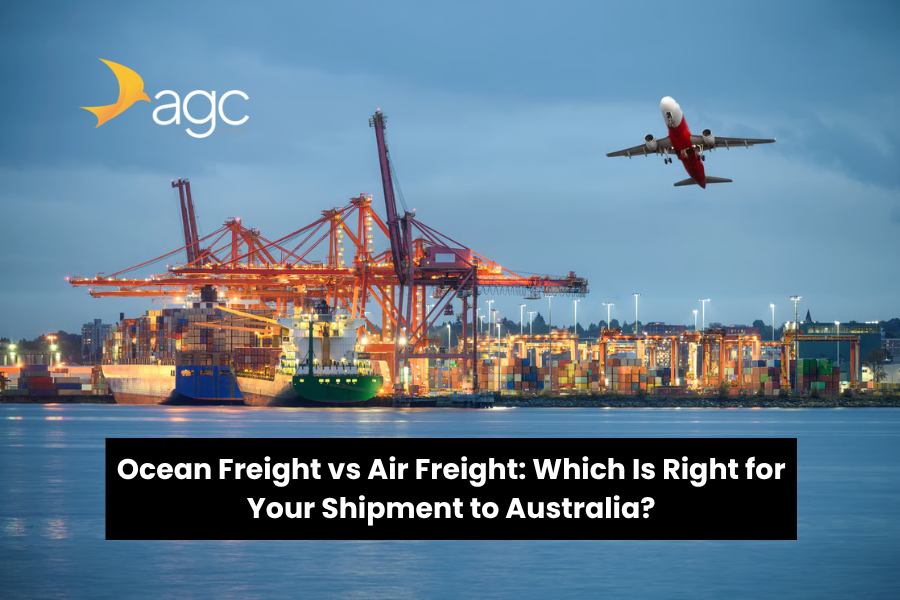
The fundamental distinction between ocean freight vs air freight Australia exists because three main elements which are Cost Speed and Reliability define it.
- Air Freight: Best for high-value, low-weight, or time-critical goods. The cost to ship goods from Asia to Australia will take 3 to 8 days while the shipping rates range between US4 to US9 per kilogram based on chargeable weight.
- Ocean Freight: The gold standard for bulk, heavy, or cost-sensitive goods. The shipment will take 25 to 45 days, which depends on the chosen route, while FCL (Full Container Load) rates offer 5 to 6 times lower costs per unit than air transport.
- The 2026 Factor: Fuel surcharges are currently the primary driver of volatility. Air freight is experiencing difficulties because the flights have been redirected, whereas sea freight maintains its prices through blank sailings which help control shipping capacity.
Understanding the 2026 Logistics Landscape in Australia
As we move through 2026, the Australian logistics scene isn’t what it used to be. We’ve seen a shift from just-in-time to just-in-case inventory management.
The Rise of Fuel and Emergency Surcharges
If you’ve looked at your recent invoices, you’ve probably noticed that the “base rate” is only half the story. In April 2026, fuel levies across Australian networks have effectively doubled in some sectors. Major shipping lines like MSC and Maersk have implemented Emergency Bunker Surcharges to account for global oil volatility. Your freight cost analysis needs to include the complete invoice amount instead of just the main rate which appears on the invoice.
Biosecurity and the BMSB Factor
Australia’s biosecurity is tighter than ever. If you’re using sea freight shipping for “target high-risk” goods between September and April, you must deal with the Brown Marmorated Stink Bug (BMSB) measures. For 2026, South Korea and Japan have been added to the emerging risk list. Failure to plan for offshore treatment can lead to your cargo being turned away at the heads, a nightmare scenario for any importer.
Air Freight: When the Need for Speed Wins
In a market where customer expectations are higher than ever, air freight remains the silver bullet for urgent restocking.
1. High-Value and Sensitive Cargo
If you’re shipping medical devices, high-end electronics, or luxury jewelry, the “landed cost” of the freight is often a small percentage of the product’s value. More importantly, air freight involves significantly less handling and a shorter “exposure window” for theft or damage. It’s the premium logistics solutions choice for premium goods.
2. Tightening Capacity and Rerouting
Currently, air freight capacity into Australia is under pressure. Middle East airspace restrictions have forced many carriers to reroute, which increases fuel burn and reduces the maximum payload planes can carry. This is why we’re seeing air rates remain elevated. If you need it yesterday, you must be prepared to pay the 2026 “security premium.”
3. Inventory Agility
For E-commerce businesses in Australia, air freight is the ultimate tool for testing the market. Instead of committing to a full container of a new product that might take 40 days to arrive, you can air freight a smaller batch, gauge the vibe of the Aussie consumer, and then commit to a sea shipment for the bulk order.
Ocean Freight: The Heavy Lifter of the Aussie Economy
For the vast majority of our industrial and retail sectors, sea freight shipping is the only way to move volume without blowing the budget.
1. The Economy of Scale (FCL vs LCL)
- FCL (Full Container Load): If you can fill a 20ft or 40ft box, you’re looking at the most efficient way to ship. In 2026, carriers are actively managing capacity, so booking your FCL space 3–4 weeks in advance is now the “new normal” for Australian importers.
- LCL (Less than Container Load): Perfect for SMEs. You share space with other shippers and only pay for the cubic meters (CBM) you use. It’s the gateway to international trade for many growing Aussie brands.
2. Strategic Lead Time Planning
The biggest hurdle with ocean freight is transit time. With current transshipment delays in hubs like Singapore, a shipment from Europe can easily push past the 50-day mark. The trick in 2026 is building a buffer into your supply chain. Smart businesses are now ordering their Christmas stock in July to ensure it clears Australian customs before the December rush.
3. Environmental and Sustainability Trends
Sustainability is no longer a nice to have. Under new Australian reporting standards for 2026, many larger companies must report their Scope 3 emissions. Sea freight shipping is roughly 10–20 times more carbon-efficient than air freight. If your brand is built on “green” values, the ocean is your best ally.
Freight Cost Comparison: A 2026 Reality Check
Let’s talk about numbers. Please note these are indicative averages for the 2026 Q2 period for the Asia-Australia lane.
| Factor | Air Freight | Ocean Freight (LCL/FCL) |
| Base Rate | US$4.50 – $9.00 per kg | US$50 – $160 per CBM (LCL) |
| Fuel Surcharge | High & Volatile (15-30%) | Moderate (Bunker Surcharges) |
| Transit Time | 3 – 8 Days | 22 – 45 Days |
| Best For | Tech, Pharma, Urgent stock | Bulk, Furniture, Raw materials |
| Carbon Impact | ~500g CO2 per tonne-km | ~10-40g CO2 per tonne-km |
Why Use an International Freight Forwarder?
Managing cargo shipping Australia isn’t just about picking a plane or a boat; it’s about navigating the red tape. This is where AGC Global Australia earns its keep.
- BMSB & Quarantine Expertise: We ensure your sea freight meets all DAFF requirements before it leaves the origin port, avoiding thousands in “onshore treatment” fees.
- Hybrid Solutions: Sometimes the answer is both. We can move your goods by sea to a hub like Singapore and then fly the urgent half into Sydney while the rest follows by water.
- Customs Clearance: Our experts handle the Australian Border Force (ABF) paperwork, so your goods don’t get stuck in Customs Limbo.
- Digital Visibility: In 2026, I don’t know where it is doesn’t fly. We provide real-time tracking so you can manage your warehouse labor and customer expectations accurately.
Frequently Asked Questions
How long does ocean freight vs air freight Australia take in 2026?
Asian central airports ship air cargo which reaches customers within 3 to 8 days between collection and delivery including the customs process. The ocean freight process experiences delays because of Singapore’s transshipment congestion which results in shipments taking 25 to 45 days to reach their destination. We recommend adding a 7-day buffer to any sea freight arrival estimate to account for current Australian port delays and biosecurity inspections.
What are the main drivers of freight costs in Australia this year?
The primary drivers for 2026 are fuel surcharges and emergency bunker levies. Due to geopolitical tensions affecting oil supply, air carriers have increased fuel surcharges by up to 15%. On the sea, blank sailings have reduced available space, allowing shipping lines to maintain higher base rates despite fluctuating global demand for bulk cargo.
Do I need special treatment for sea freight due to stink bugs?
Yes, if you’re importing target high-risk goods from countries like the USA, China, or the newly added Japan and South Korea between September and April. This Brown Marmorated Stink Bug (BMSB) measure requires mandatory offshore treatment. Failure to comply often results in the Australian Border Force directing the cargo for immediate export.
Is air freight or sea freight better for my carbon footprint?
Sea freight is significantly better for the environment. Sea shipping operations emit 10 to 40 grams of carbon dioxide for each tonne shipped during one kilometre while air freight operations emit approximately 500 grams. Australian businesses can achieve their 2026 sustainability targets through ocean freight transportation which serves as their most efficient emissions reduction method.
Can a freight forwarder help reduce my total land costs?
An international freight forwarder like AGC Global reduces costs by leveraging volume discounts with carriers and avoiding expensive mistakes. Our company operates as a hybrid logistics provider which delivers speed and cost-effective solutions that enable customers to save 20 to 30 percent on their urgent delivery needs.
What is chargeable weight in air freight calculations?
Airlines charges are based on either the actual gross weight or the volumetric weight of the cargo, whichever is greater. Volumetric weight is calculated by multiplying the dimensions and dividing a set factor. This means if you ship a large box of pillows, you’ll be charged for the space they occupy rather than their light actual weight.
Conclusion
At the end of the day, there’s no right answer in the ocean freight vs air freight Australia debate, there’s only the right answer for your specific shipment.
If you’re facing a stockout on your best-seller and your customers are screaming, the premium for air freight is worth every cent to protect your brand reputation. But if you’re building long-term growth and want to keep your retail prices competitive, mastering the art of sea freight shipping is your path to success.
In 2026, the key is flexibility. Don’t get locked into one mode. Work with a partner who can pivot your strategy as the market changes.
Ready to get your goods moving?
Don’t let shipping logistics give you a headache. Whether you need the speed of the sky or the scale of the sea, AGC Global Australia has the local expertise and global reach to get it done right. We’ll handle the surcharges, the stink bugs, and the paperwork so you can focus on growing your business.
Contact AGC Global today for a tailored quote and let’s find the perfect logistics solutions for your next shipment!